
There are moments where setting a boundary feels less like sending a text message and more like preparing for battle.
Your heart starts racing. Your stomach twists into knots. You rehearse the conversation over and over in your head, imaging every possible response and outcome. You know what you need to say. You know the boundary is reasonable, yet somehow pressing send feels impossible.
If you’ve experienced this, you’re not alone.
For many people, confrontation isn’t just uncomfortable. It feels genuinely threatening.
Why Does Confrontation Feel So Scary
The truth is, most of us weren’t born fearing confrontation.
Somewhere along the way, we learned that speaking up came with consequences.
Maybe expressing your needs was met with criticism.
Maybe saying “no” made someone angry.
Maybe, you were taught to keep the peace, avoid conflict, or put everyone else’s needs before your own.
Over time, your brain begins to associate confrontation with danger. Even when you’re safe, your nervous system reacts as though your facing a real threat.
That’s why your body responds before your mind even has a chance to catch up.
When people talk about setting boundaries, they often make it sound empowering. And sometimes it is.
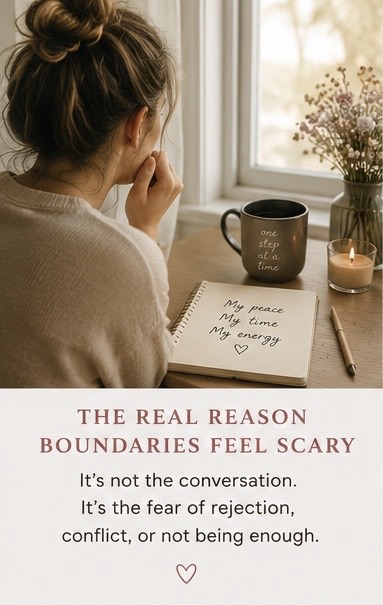
But before it feels empowering, it usually feels terrifying. Especially if you’ve spent years being the peacekeeper, the people-please, the one who says it’s okay when it isn’t. The one who carries the emotional weight so everyone else can stay comfortable.
When that’s been your role for long enough, boundaries don’t feel natural, they feel selfish.
Not because they are selfish. But because you’ve been conditioned to believe that your needs should come second. And every time you choose yourself, it can feel like breaking a rule that you’ve spent years following.
Why Anxiety Shows Up
One thing I wish more people understood is that anxiety doesn’t always just show up because you’re in real life danger.
Sometimes it shows up because you’re doing something unfamiliar. And your body doesn’t always know the difference.
Mine certainly didn’t.
Whenever I needed to have a difficult conversation, my body reacted as though I was walking into a crisis.
Racing heart. Sweaty palms. Tight chest. Dry mouth.
An endless loop of worst-case scenarios playing through my head.
Looking back I wasn’t actually scared of the conversation itself. I was scared of rejection. I was scared of conflict. I was scared that someone would be angry at me. And if I’m being honest, I was scared they’d stop liking me all together.
That’s the part that many people don’t speak about. Sometimes boundary setting forces us to confront a deep fear.
“What if choosing myself, costs me this relationship?”
What Actually Helped Me
The biggest shift came when I stopped trying to make the anxiety disappear before setting the boundary.
For years I believed I needed to feel confident first. I thought there would be a moment where I’d suddenly feel brave enough.
That moment never came.
And I realised, people I admired weren’t speaking up because they weren’t scared, they were speaking despite being scared.
Once I understood that, everything changed.
Instead of asking myself:
“How do I stop feeling anxious?” I started asking “How do I support myself through the anxiety?”
That question led me to a few things that genuinely helped.
Write It Before You Say It
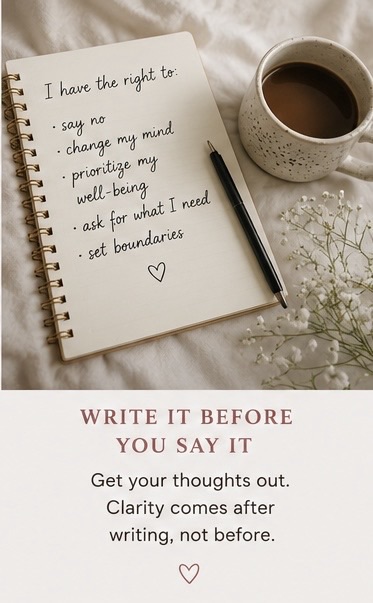
If emotions are running high, write everything down first.
Not necessarily to send, just to get it out.
Half the battle is untangling what you’re actually feeling.
I’ve lost count of how many times I’ve sat down to write a message, convinced I was angry, only to realise I was actually hurt. Or convinced I was upset with someone else, only to discover I was frustrated with myself for staying silent for so long.
Writing gives you a space to separate your emotions from the panic. It helps you identify what the real issue is and what outcome you’re hoping for.
When our thoughts stay trapped in our minds, they tend to grow bigger, louder, and more overwhelming. Putting them on paper can make them feel manageable again.
You don’t need to write the perfect message, or have the perfect words. You just need somewhere to start.
Because clarity often comes after writing, not before.
Stop Rehearsing Their Side
This one is hard!
If you’re anything like me, you’ve probably had entire arguments in your head before the other person even knows there’s an issue.
The problem is that we’re often reacting to imaginary outcomes.
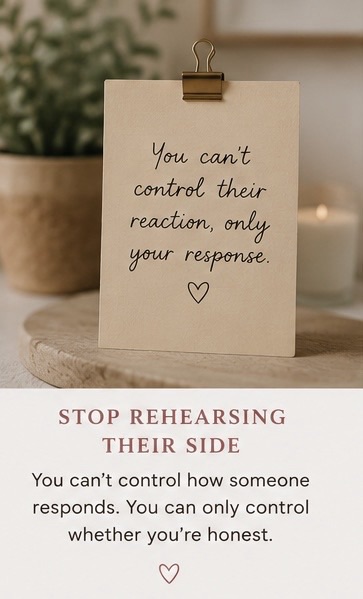
You can’t control how someone else responds. You can only control whether you’re honest.
I used to spend days preparing for conversations that hadn’t even happened yet. I’d imagine every possible reaction: anger, disappointment, defensiveness, silence and rejection. I’d create entire scenarios in my head and then feel emotionally drained before I had even said a single word.
More often than not, the actual conversation looked nothing like any of the ones I had rehearsed.
The truth is, no amount of overthinking can guarantee a particular response.
You can’t perfectly predict how someone will react, you can’t control how they understand, and you can’t force them to agree with you.
And carrying the weight of trying to manage someone else’s feelings before they’ve even had them is exhausting.
One thing I’ve had to remind myself is that my job isn’t to script the entire conversation. My job is simply to show up honestly, communicate clearly, to say what needs to be said with kindness and respect.
The rest belongs to them.
Sometimes people respond better than we expected, sometimes they don’t. But avoiding the conversation doesn’t protect us from discomfort. It just delays it.
I’ve found that the moment I stop trying to control the outcome and focus on being truthful instead, the anxiety loses some of its power.
Because boundaries aren’t about getting the perfect response. They’re about expressing what’s true for you regardless of how it’s received.
Let Your Body Be Uncomfortable

This sounds strange, but it helped me a lot.
When my heart starts racing before a difficult conversation, I no longer treat it as proof that I’m making a mistake.
I treat it as proof that I care.
For a long time, I believed that if I felt anxious about something, it must mean I shouldn’t do it. I thought confidence looked like feeling calm, certain, and completely unbothered.
But that’s not how it works.
Some of the most important conversations you’ll ever have will make you uncomfortable. Not because they’re wrong, but because they’re important.
I’ve learned that anxiety isn’t always a warning sign. Sometimes it’s simply a sign that you’re stepping out of what you’re used too.
If you’ve spent years avoiding conflict, people-pleasing, or keeping your feelings to yourself, speaking up is going to feel uncomfortable at first. Your body is doing something unfamiliar and unfamiliar things often trigger anxiety.
That doesn’t mean you need to stop, it means you’re growing.
Now when I feel my chest tighten or my stomach full with nerves, I try not to fight it. I don’t wait until the anxiety disappears before I act, because I’ve realised that waiting for the perfect moment usually means waiting forever.
Instead I acknowledge it:
“I’m anxious right now, and that’s okay.”
“This conversation matters to me, and that’s why I’m nervous.”
“I can be uncomfortable and still do this.”
I bring the anxiety along with me for the ride. It just isn’t the one driving anymore.
Because every time I let fear make the decision, I stay stuck in the same vicious cycle. I stay silent when I want to speak. I say yes when I want to say no. I carry resentment instead of addressing the problem.
I’ve discovered that courage isn’t the absence of anxiety.
Courage is feeling the racing heart, the shaky hands, the knot in your stomach. And choosing to speak anyway.
The more you do it, the more your body learns that discomfort doesn’t equal anger.
And eventually, what once felt impossible starts to feel manageable.
Remember What You’re Protecting
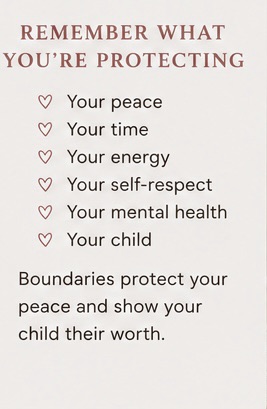
Every boundary protects something.
Whether it’s your peace, your time, your energy, your self-respect, your mental health.
When I focus on what I’m protecting instead of what I’m risking, speaking up becomes easier.
For a long time, I only focused on what I stood to lose. What if they got upset? What if they misunderstood me? What if they thought I was selfish? What if it changed the relationship?
I spent so much time worrying about everyone else’s feelings, that I forgot to consider my own.
What about my stress levels?
What about the resentment that built every time I said yes when I wanted to say no?
What about the exhaustion that came from constantly putting others needs ahead of my own.
Eventually I realised that every time I avoided setting a boundary, I was still paying a price. The conflict I was trying to avoid didn’t disappear. It simply turned inward. It showed up as anxiety, frustration, burnout, and a growing feeling that I wasn’t being true to myself.
That’s when I started asking a different question.
Instead of asking, “What if they don’t like this boundary?” I started asking “What happens if I don’t set it?”
The answer was usually more concerning.
As parents,this becomes even more concerning.
Because boundaries aren’t just about protecting ourselves anymore.
They’re also about protecting our children.

Children learn what healthy relationships are by watching us. They notice how we allow others to treat us. They notice whether we speak up when something doesn’t feel right .
If we want our children to grow up knowing their feelings matter, we have to show them ours matter too.
If we want them to be able to say no to things that make them uncomfortable, we need to model that ourselves.
If we want them to understand that love and respect can exist alongside boundaries, they need to see us practicing that in our own lives.
And we are responsible for setting boundaries for them until they are able to.
And responsible for teaching them that boundaries aren’t about shutting people out, they’re about protecting what matters most.
The Boundary That Changed Everything
One day I realised something. Every time I avoided the difficult conversation, the anxiety didn’t disappear. It just moved.
The discomfort I avoided in the moment, showed up later in resentment.
Exhaustion, overthinking, frustration, distance.
The conversation I was avoiding never actually went away.
I just carried it around with me.
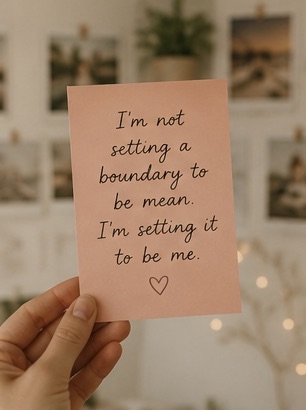
That was the moment I understood that boundaries aren’t here to create conflict.
They’re here to prevent it.
They’re not just walls.
They’re instructions for how to stay in a healthy relationship with yourself and others.
Final Thoughts
If setting boundaries makes you physically anxious, you’re not alone.
Many of us learned that keeping peace was safer than speaking up.
But there comes a point where protecting everyone else’s discomfort starts costing us our own.
The goal isn’t to become someone who never feels nervous.
The goal is to become someone who trusts themselves enough to speak anyway.
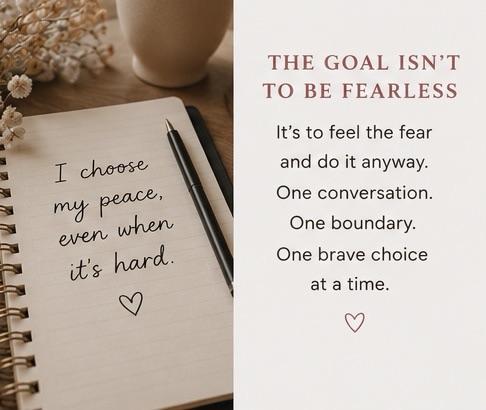
Even if that’s with a racing heart and shaky hands.
Even when anxiety is screaming at you to stay silent.
Because your needs matter too.
- Why Setting Boundaries Feels So Scary: How to Handle Confrontation When Anxiety Takes Over
- The Threat of The Room
- The People Who Stay During Hard Seasons
- 10 Things I Wish Someone Told Me About Motherhood.
- The Day I Realised I Wasn’t The Same Anymore (When The Brain Develops)

Stillfiguringlifeout.blog
 stillfiguringlifeoutblog