
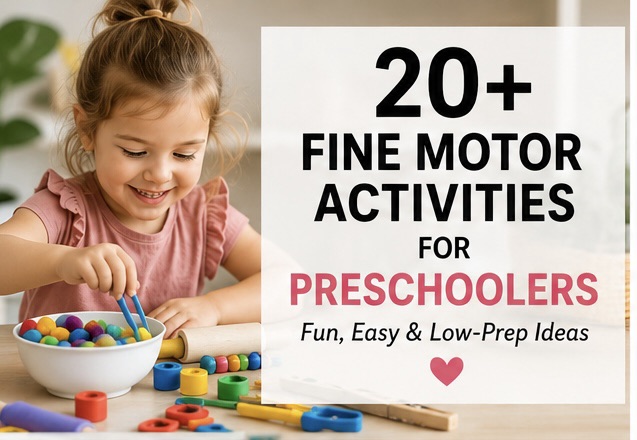
We often think of “school readiness” as knowing letters or counting to ten. But before a child can master the pencil, they need to master the muscles. Fine motor skills, those small, precise movements of the hands and fingers, are the hidden foundation for everything from self-confidence to academic success.
The best part? You don’t need expensive toys or structured “lessons” to build them. In fact, some of the most effective fine motor work is done through the play preschoolers love most.
Why Does It Matter?
Fine motor development is about more than just handwriting. It’s about autonomy. When a child can manipulate small objects, they can dress themselves, feed themselves, and express their creativity without frustration. It builds the hand strength and coordination they’ll rely on for the rest of their lives.

Everyday Play: 5 Simple Ways to Build Strength
If you’re looking for low-pressure, high-impact activities, try intergrating these into your day.
- The “Pincer” Power-Up: Encourage your child to use tools like kid-safe tweezers or kitchen tongs to sort objects. Whether it’s moving pom-poms into a muffin tin or “rescuing” plastic animals from a bin of dried rice, that squeeze-and-release motion is exactly what strengthens the fingers for a future pencil grip.

- Water Play with a Purpose: Give them a squirt bottle or a medicine dropper to “paint” the fence with water or transfer colourful water between cups. It turns a simple sensory activity into a serious workout for hand muscles.
- Nature’s Loose Parts: On your next walk, collect rocks, leaves, sticks. Back home have them place these inside drawn circles on a piece of paper. The precision required to place objects within a target is a fantastic way to develop spatial awareness and control.
- Dough Magic: There is a reason play dough has stayed a classroom staple for generations. Rolling, squishing, poking, and hiding “treasures” (like beads) inside the dough for them to dig out builds incredible resistance and finger strength.

- Dressing for Independence: It sounds simple, but managing buttons, zppers, and even “practising” with snap-on toys are the gold standards of fine motor development. It turns a chore into a puzzle-solving game.
- Catalog Collages: From junk mail to masterpieces. It’s easy to look at a pile of store catalogs and see “junk mail.” But to a preschooler, those same pages are a treasure trove of images, textures, and potential stories. This activity hits two major developmental milestones: scissor skills and creative story telling. Using child-safe scissors to navigate around shapes or objects requires incredible hand-eye coordination. Once they’ve cut out their “treasures,” they have to use spatial awareness to arrange and glue them into a brand-new picture.

- Tracing Names: there is something deeply satisfying for preschoolers about seeing their own name on paper tracing it isn’t just about learning to write, it’s about learning the “map” of their name. It helps children develop pencil control, letter recognition, and patience. Create a simple document with their name in a large, dotted-line font.
Free Fine Motor Skills for Preschoolers Printable
Download this free printable with 30 fine motor activities to try with your child to help improve their fine motor skills to help be school ready.
The “Secret” Ingredient: Follow Their Interest
The most important rule in child development is that consistency beats intensity. You don’t need an hour of “fine motor time.” Five minutes of squishing dough or helping you stir a bowl of ingredients is more than enough to make a difference.
If your child loves cars, have them “wash” toy vehicles with a sponge (the squeezing motion is perfect!) If they love nature, have them peel the paper off a crayon to do leaf rubbings. When we follow their interest, the work stops feeling like a task and starts feeling like play.

A Gentle Note on Patience
Some days, those tiny fingers will struggle to get the button through the hole, or the bead onto the string. That’s okay. These skills aren’t built in a day. The focus shouldn’t be on the “perfect” outcome, but on the effort they are putting in. Every time they try, their muscles are getting a little stronger, and their confidence is growing.
What is on “everyday” task or toy your preschooler loves right now that we could turn into a little fine motor workout?
Leave a Reply